If you have ever asked yourself, what are the benefits of scheduling SMS campaigns for my business, the short answer is: time saved, fewer costly errors, and measurably higher engagement. But the full picture is worth understanding properly, because the gap between manual SMS sending and a properly scheduled campaign is wider than most Nigerian business owners realise.
Picture this: it is 11:47 PM on a Wednesday. A member of your team is hunched over a laptop, manually uploading contacts and hitting “send” on a promotional message that was supposed to go out that morning. The timing is off, the copy was never proofread, and three hundred of those numbers are sitting on the NCC DND registry. By Thursday morning, you have opt-outs, zero responses, and a campaign that cost more in staff hours than it will ever return. This is the reality of ad-hoc SMS marketing, and it is far more common than most Nigerian businesses would like to admit.
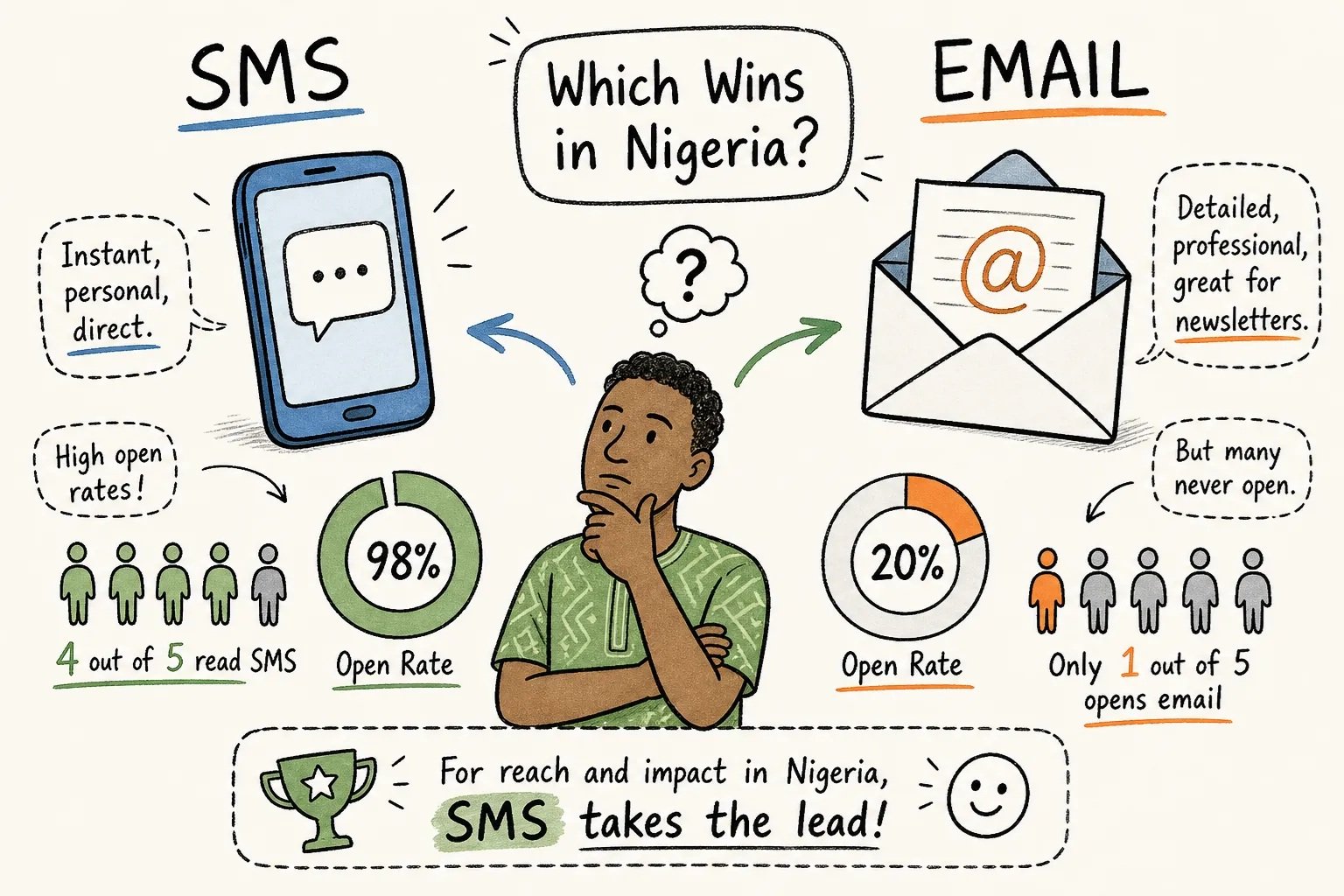
SMS remains the most powerful direct channel available to Nigerian businesses, with open rates hitting 98% and click-through rates landing between 18% and 35%, numbers that email marketing cannot come close to matching. But raw channel performance only converts into revenue when messages reach customers at the right moment and with the right content. That is exactly what campaign scheduling delivers. Platforms like Nigeria Bulk SMS include a built-in campaign scheduler that lets you queue messages days or weeks ahead, so your team can step away from the dashboard and focus on what actually grows the business.
By the time you finish reading, you will understand the practical advantages of scheduling SMS campaigns, know the optimal windows for reaching Nigerian customers, and have a concrete 30-day framework to launch your first scheduled campaign with confidence.
Why manual SMS sending is holding your business back
The hidden cost of ad-hoc messaging
Every time a team member stops what they are doing to manually send a campaign, the business absorbs a cost that never appears on any invoice. Staff time, mental attention, and operational momentum all drain away. The deeper damage, though, is inconsistency: campaigns launch late, follow-up messages get forgotten, and the customer experience becomes erratic. Customers who receive a promotional message from you today and hear nothing for three weeks do not feel loyalty. They feel indifference.
The compounding effect is real. Businesses that rely on someone remembering to hit “send” will always have gaps in their communication calendar. Think of a Lagos fast-food chain that goes silent for a fortnight while a competitor’s scheduled campaign lands in customers’ inboxes every Thursday morning. In Nigerian retail and services, that gap costs more than a few conversions, it costs the relationship.
What are the benefits of scheduling SMS campaigns for my business?
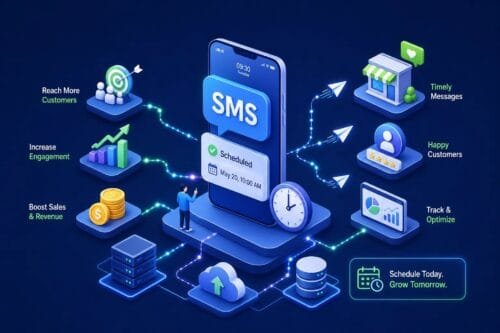
Campaign scheduling is not simply a convenience feature. It is a structural fix for the operational instability that manual sending creates. When you build a campaign in advance and set it to deliver at a specific date and time, execution becomes predictable and independent of whoever happens to be at their desk that day. The message goes out whether your team is in a client meeting, at a trade fair, or asleep.
Nigeria Bulk SMS allows users to queue individual messages or full campaign sequences days and weeks ahead, directly from the web dashboard. That means your Monday planning session can produce a full week of customer touchpoints without a single manual action on the days they are delivered.
How SMS automation saves time and cuts costly errors
Setting it once and letting it run
The practical mechanic is straightforward. A business owner drafts a campaign on Monday, schedules it for Thursday at 10 AM WAT, and closes the browser. On Thursday morning, the message delivers to every contact on the list without anyone touching the system. Compare that to the manual alternative: someone has to remember, log in, upload contacts, verify the copy, and send, all while managing everything else on their plate.
The revenue case for this approach is well-documented in industry benchmarks. According to data published by Omnisend and cited widely in SMS marketing research, automated messaging flows generate significantly more revenue per send than manually triggered campaigns, in some analyses, nearly five times more per message. That gap exists because timing and consistency compound: a customer who receives a well-timed message on three consecutive Thursdays is far more primed to act than one who receives random messages at unpredictable intervals.
Fewer mistakes, more reliable delivery
Scheduling introduces a review stage that manual sending rarely gets. When a campaign is built in advance and set to go live later, there is a natural checkpoint to verify the contact list, confirm the sender ID, review the copy, and check for duplicates before anything is sent. Ad-hoc campaigns bypass this stage almost by definition, which is why they generate the highest rate of errors.
Pre-scheduling also creates the space needed for NCC compliance checks. Senders can scrub their recipient lists against the DND registry, confirm that message templates are registered with the NCC, and verify that opt-out instructions are clearly included, all before the campaign goes live. These steps are not optional; they are the foundation that keeps campaigns running without regulatory disruption.
Reaching Nigerian customers at exactly the right moment
The best time to send SMS campaigns to Nigerian audiences
Timing is not a minor detail in SMS marketing. It is a primary lever. For Nigerian audiences, the highest engagement windows are 10 AM to 12 PM and 2 PM to 5 PM WAT, with Tuesday through Thursday delivering the strongest response rates. A message sent at 11 PM WAT is almost guaranteed to be ignored at best, and at worst, it triggers an opt-out from a customer who was previously engaged with your brand.
Nigeria operates on a single time zone, WAT (UTC+1), which simplifies scheduling considerably. You do not need to segment by region within the country. A single campaign scheduled for 10:00 AM WAT reaches Lagos, Abuja, Kano, and Port Harcourt simultaneously, all during the morning engagement window. What matters is that your scheduling tool locks in WAT accurately, not UTC or any other reference point. For additional guidance on optimal send times and global timing research, see best practices for the best time to send SMS.
Why consistent timing beats high volume
A common misconception among Nigerian business owners is that sending more messages produces more results. It does not. A business that sends three well-timed, well-crafted scheduled messages per week will consistently outperform one that blasts daily at random hours. Volume without precision is just noise. Industry data consistently points to significant concentrations of SMS-driven purchasing activity during evening hours, which makes timing a deliberate lever rather than an afterthought.
Scheduling transforms timing from guesswork into a repeatable system. Once you identify the windows that work for your specific audience, your campaigns lock into those windows automatically, every time, without manual intervention or the risk of a message going out at midnight because someone was in a hurry.
Building consistent customer engagement over time
Staying visible without being a burden
Customers who hear from a brand consistently and relevantly begin to anticipate those messages. A weekly offer from a retailer, a monthly loyalty update from a salon, or a post-purchase follow-up from an e-commerce store all build a rhythm that feels like a relationship rather than an interruption. That consistency is only achievable through scheduling. Manual sending will always produce gaps, and gaps erode the trust that regular, relevant communication builds.
The contrast with erratic campaigns is stark. A business that sends three messages in one week and then goes silent for a month does not feel reliable. Customers notice the inconsistency, even when they cannot articulate why, and their engagement drops accordingly. For more on how SMS can directly improve engagement and customer experience, read this overview of how SMS enhances customer engagement.
Key benefits of scheduling SMS campaigns: segmentation and precision
Scheduling delivers its full value when paired with contact list segmentation. A business can build separate scheduled campaigns for new customers, repeat buyers, and dormant contacts, each receiving a message relevant to their relationship with the brand, delivered at an optimal time, without any manual sorting on the day of delivery. Industry research consistently shows that personalised, segmented campaigns drive meaningfully higher conversion rates than generic broadcasts, with some studies pointing to lifts of up to 23%.
Nigeria Bulk SMS supports both a Phonebook Directory for organised contact storage and Text Merge for personalised messaging, which means segmentation and scheduling work together within a single platform rather than requiring separate tools. For a deeper look at elements that make campaigns effective in Nigeria, see our article on 3 Crucial Factors for Effective Bulk SMS Campaigns in Nigeria.
Real-world use cases that drive measurable results
Flash sales and time-sensitive promotions
A retailer in Lagos schedules a “today only” offer for 10 AM WAT on payday Friday. The campaign was built three days earlier, so the copy is sharp, the CTA is clear, and the contact list has been scrubbed. Because the message arrives exactly when customers have money in hand and are actively making spending decisions, the response rate reflects that precision. SMS achieves click-through rates of 18% to 35%, compared to 2.5% to 3.5% for email, and a flash sale scheduled to land at the right moment captures that advantage in full.
With the entire sequence built and queued in advance, there is no last-minute scramble on the day. The promotion runs exactly as planned, and your team’s attention stays on fulfilling orders rather than managing the send.
Appointment reminders that actually reduce no-shows
A clinic, salon, or professional services firm can schedule reminder messages 24 hours and 2 hours before each appointment slot, automatically, without any staff action on the day itself. The Oladoc case study provides a concrete benchmark: automated SMS appointment reminders achieved a 90% delivery rate and measurably reduced patient no-show rates. For any Nigerian business that runs on appointments, those no-shows represent direct revenue loss, and scheduling removes the manual effort that makes consistent reminders impractical at scale.
Event countdowns and seasonal campaigns
A product launch countdown, an Eid campaign series, or an end-of-year sale sequence all require multiple messages delivered at precise intervals. These multi-message sequences are only feasible at scale when scheduled in advance. Building and delivering a five-message countdown manually, while managing everything else in the business, is the kind of task that either gets done poorly or does not get done at all. Scheduling makes it routine.
Planning your first 30-day scheduled SMS campaign
A practical week-by-week structure
A structured first month removes the guesswork and gives you real data to build on. Here is how to approach it:
- Week 1, Foundation: Build your contact list and segment it into at least three groups: new contacts, active customers, and dormant contacts. Confirm that all numbers are scrubbed against the NCC DND registry before you go any further.
- Week 2, Onboarding: Draft and schedule a welcome sequence for new contacts, a simple two-message flow that introduces your brand and sets expectations for future communication.
- Week 3, Engagement: Add a promotional or engagement message for your active customer segment, timed to a mid-week morning window when response rates are strongest.
- Week 4, Review: Pull the delivery reports, check response rates, review any opt-outs, and adjust your timing or segmentation for the next cycle based on what the data shows.
The metrics that tell you if it is working
Five numbers tell the full story of a scheduled SMS campaign: delivery rate, response rate, click-through rate (if links are included), opt-out rate, and revenue attributed to each campaign. Nigeria Bulk SMS provides real-time delivery reports directly within the platform, so tracking these numbers does not require a separate analytics tool or any technical setup. If your delivery rate is low, the problem is usually the contact list. If your opt-out rate is climbing, the frequency or timing needs adjustment.
NCC compliance before you launch
Three requirements are non-negotiable before any campaign goes live. First, express consent must be documented for every number on your list. Second, your message templates must be registered with the NCC before sending. Third, every message must include a clear opt-out instruction, and the list must be scrubbed against the DND registry before each campaign.
Compliance is not a bureaucratic hurdle; it is the infrastructure that keeps your campaigns running. A campaign that violates NCC guidelines does not just fail, it can result in your sender ID being blocked, which disrupts every future campaign you plan to run. For a practical overview of the legal and regulatory aspects of bulk SMS in Nigeria, consult this guide on bulk SMS legal and regulatory aspects in Nigeria.
Start scheduling and stop scrambling
So, what are the benefits of scheduling SMS campaigns for your business? Fewer errors, better timing, higher engagement, and the kind of consistent customer communication that ad-hoc sending simply cannot sustain. The advantages compound quickly once you establish a rhythm, and they are accessible to any Nigerian business, not just large enterprises with dedicated marketing teams.
Nigeria Bulk SMS is built specifically for this market. Naira-based billing means no currency conversion surprises, a built-in campaign scheduler means no third-party tools, and real-time delivery reports mean you always know exactly what your campaigns are doing. Backed by over 15 years of local operating experience, the platform handles both the technical side and the practical detail, so you can focus on strategy rather than execution. If you want to see how other businesses added SMS to their marketing mix and maximised sales, read our Selligate case study on How to Add SMS to Your Marketing Plan to Delight Customers and Maximize Sales.
Register on Nigeria Bulk SMS today, build your first scheduled campaign, and send your next message at exactly the right moment, without anyone having to stay up to make it happen. If you need step-by-step help getting started on the platform, see our complete beginner’s guide to sending bulk SMS on the Nigeria Bulk SMS website.