If you have ever asked yourself, “How to start a bulk SMS reseller business in Nigeria?”, this guide gives you the complete answer. Picture a Lagos-based entrepreneur who sells fast-moving consumer goods: decent money, but thin margins, exhausting logistics, and every month feeling like starting from scratch. Then a friend mentions he earns a steady ₦2,000,000 monthly just by reselling bulk SMS credits to schools, logistics companies, and local retailers in his city. No warehouse. No delivery van. No perishable stock. Just a white-label platform, a list of clients, and a margin on every message sent. That is the bulk SMS reseller business in a single picture.
The opportunity is real, and it is not new. Nigeria Bulk SMS has been running a reseller program since the early days of commercial SMS in Nigeria, and the businesses built on that program have grown alongside the country’s expanding digital economy. What makes this model compelling in 2026 is that demand for SMS has not shrunk. Banks need OTP delivery. Schools need fee reminders. Hospitals need appointment alerts. Logistics firms need dispatch notifications. Most of those businesses would rather buy SMS credits from a local contact who provides support than navigate a provider’s sign-up page on their own.
By the end of this guide, you will have a clear, step-by-step roadmap: how the reseller model works, how to pick the right partner, what compliance looks like, how to set up your platform, what it costs, and how to land your first paying clients.
Understanding how the bulk SMS reseller model actually works
Before you spend a kobo on setup, you need a clear mental model of how money flows in this business. Three layers make up the SMS supply chain. At the top sit the mobile network operators: MTN, Airtel, Glo, and 9mobile. In the middle are licensed SMS aggregators and gateway providers who buy wholesale capacity from the MNOs and build the infrastructure to route messages reliably. At the bottom is you, the reseller, who purchases credits from a gateway provider at a wholesale rate and sells them to end clients at a retail margin.
How buying wholesale and selling retail generates your margin
The numbers are straightforward once you see them clearly. If you buy SMS units at ₦6.00 per message and sell them to clients at ₦8.00, your margin is ₦2.00 per message. That sounds modest, but consider a single client sending 50,000 messages a month: that is ₦100,000 in gross profit from one account. Multiply that across ten active clients and the business starts making real sense. The spread isn’t enormous per unit, but volume compounds it quickly, especially when clients use SMS as part of their routine operations rather than for occasional campaigns.
Why the Nigerian SMS market keeps creating room for new resellers
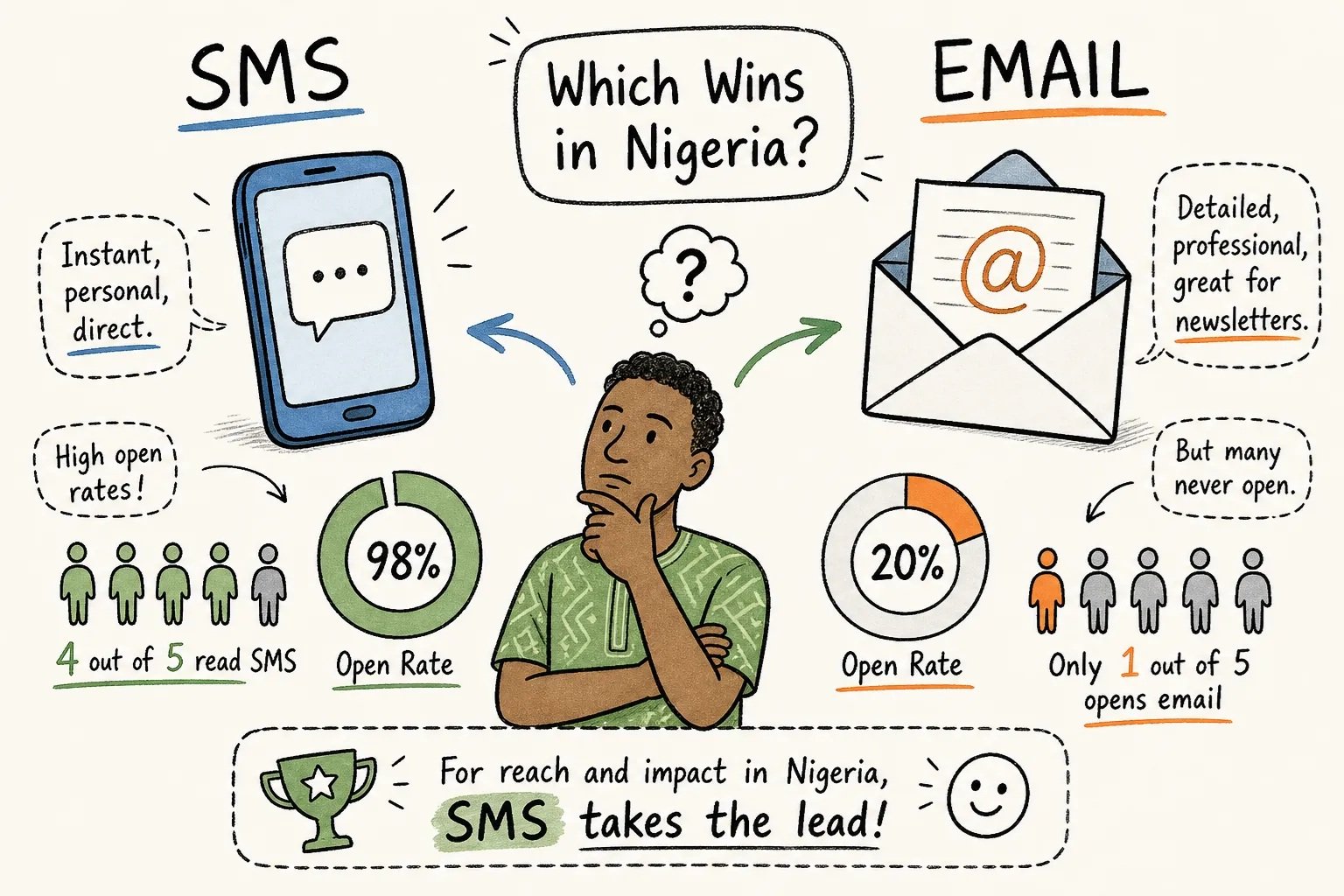
In parts of South-East Asia and Western Europe, SMS demand has been meaningfully eroded by WhatsApp and social media at the consumer level. Nigeria has not followed that pattern, at least not at the operational level. Tens of millions of Nigerians still use feature phones. More importantly, SMS reaches the recipient without requiring an internet connection, which is precisely why banks, fintechs, hospitals, schools, and logistics companies still rely on it for transactional alerts and OTPs. As long as these institutions exist and grow, businesses will need SMS services and will look for a knowledgeable local contact to supply them, which is exactly the gap a reseller fills.
What realistic monthly income looks like at different scales
A part-time reseller managing five small-business clients, each sending roughly 20,000 messages per month, can expect around ₦200,000 in gross profit before costs. A mid-scale operation with 20 active accounts could reach ₦800,000 to ₦1 million monthly. A full-time reseller with 50 or more accounts, including some high-volume fintech or logistics clients, can build income well above ₦5 million per month. The attractive feature is predictability: once clients treat SMS as a recurring operational expense, they top up regularly without prompting, making revenue far more stable than most product-based businesses.
How to start a bulk SMS reseller business in Nigeria: choosing the right gateway partner
Your parent provider shapes everything downstream, your delivery rates, your compliance exposure, how quickly you can onboard clients, and whether your business survives a platform outage. Choosing the wrong gateway partner is the single costliest mistake a new reseller can make, and it rarely becomes obvious until a client’s OTP messages start failing at midnight.
The five criteria that separate reliable providers from risky ones
Evaluate any potential gateway partner on these five points. First, years of uninterrupted operation in Nigeria: longevity signals carrier relationships that are already established and tested. Second, Naira-based billing: a provider that invoices in dollars exposes you to exchange-rate swings every time you top up, eroding your margin unpredictably. Third, the quality of the white-label programme: you need to put your brand in front of your clients, not your provider’s name. Fourth, availability of both HTTP API and SMPP: different clients have different technical requirements, and you cannot afford to turn away a developer because your provider only offers one integration method. Fifth, responsiveness of support: when a client’s messages are not delivering, you need answers in minutes, not days.
Why Nigeria Bulk SMS is a strong starting point for new resellers
Nigeria Bulk SMS has operated continuously since 2008, meaning more than 15 years of carrier relationships, infrastructure refinement, and real-world delivery experience across all four major Nigerian networks. Billing is entirely in Naira, so your cost of stock does not fluctuate with dollar rates. The white-label reseller programme lets you present your own business name and branding to every client, meaning they interact with your brand, not the underlying platform. Both HTTP API and SMPP access are available, so you can serve a small retailer using the web dashboard just as easily as a fintech developer who needs a persistent SMPP connection for high-volume OTP traffic.
What to confirm before signing up with any parent provider
Run a brief due-diligence process before committing. Request a test account or trial credits and send messages to all four major networks; check whether delivery is fast and reports are accurate. Confirm whether the reseller dashboard lets you set custom pricing per client independently. Ask how sender ID registration requests are handled and what the typical approval timeline looks like. Verify how delivery disputes are raised and resolved. These questions take thirty minutes to ask and could save you months of frustration later.
Compliance and registration requirements you cannot skip
Skipping compliance is the most common mistake first-time resellers make. The consequences range from blocked messages to suspended sender IDs to clients publicly blaming your service for delivery failures. Getting this right before your first client goes live is non-negotiable.
When you need the NCC A2P messaging aggregator licence
The NCC requires an International A2P Messaging Aggregator Licence for businesses that aggregate and terminate international A2P SMS traffic into Nigerian networks. The current licence fee is ₦10 million for a five-year term, plus a non-refundable 5% administrative charge on submission. Applicants must be corporate entities registered in Nigeria, must show a contract with at least one Host Network Operator, and must demonstrate financial and technical capacity including fraud detection, data protection, and security monitoring systems. If you are starting as a domestic reseller working through an already-licensed aggregator such as Nigeria Bulk SMS, this direct licence requirement does not apply to you immediately. You are, however, still fully responsible for sender ID compliance and DND screening for every client you serve.
Sender ID registration across MTN, Airtel, Glo, and 9mobile
An alphanumeric sender ID must be pre-registered and approved by each major operator before your clients’ messages can be delivered reliably. The sender name must be between 3 and 11 alphanumeric characters with no special characters, and it must represent the actual brand sending the messages. You submit the request through your parent provider, who forwards the application to each network separately. Supporting documents typically include the client’s CAC registration certificate, a letter of authorisation on company letterhead, a director’s ID, a sample message, and the business address. Approval from one operator does not carry over to the others, so all four registrations must be completed for full national coverage. As a reseller, your responsibility is to collect and retain these documents for every client you onboard, this is part of what the sender ID registration process in Nigeria requires of you.
DND compliance: what resellers are responsible for
Nigeria’s Do-Not-Disturb registry restricts promotional messages from reaching opted-out numbers. Transactional messages, such as OTPs, payment confirmations, and appointment reminders, are treated differently and generally bypass DND restrictions. As a reseller, you must ensure your clients correctly classify every campaign as either promotional or transactional before it goes out. Promotional campaigns must suppress DND-registered numbers. If a sender ID is used to send promotional messages to opted-out recipients, the operator can block that sender ID at the network level, affecting every client who uses that name. Build this classification check into your client onboarding process from day one.
How to start a bulk SMS reseller business in Nigeria: setting up your technical infrastructure
With your compliance groundwork complete, you move from regulatory to operational territory. The practical setup involves three components: your integration method, your white-label portal, and your delivery reporting setup. None of these need to be complex, but all three must work reliably before your first client goes live.
HTTP API vs SMPP: matching the integration to your client type
HTTP API is the right starting point for the vast majority of new resellers. It uses standard web requests, integrates in hours rather than days, and handles the messaging needs of most Nigerian business clients without difficulty. SMPP is a persistent connection protocol better suited to high-volume clients, fintechs processing thousands of OTPs daily, for example, who need sustained throughput and deeper carrier-level control. Start every client on HTTP API. Introduce SMPP only when a client’s volume or technical requirements clearly justify the additional complexity. Most established reseller programmes provide both options, so you are covered either way.
White-label portal and client onboarding checklist
A white-label portal lets your clients log in to a dashboard that carries your brand name and logo. From the admin layer, you can create client accounts, assign sender IDs, set traffic limits, configure pricing tiers, and monitor delivery rates across your entire client base. This is the operational engine of the business. When evaluating providers, confirm how much branding control you have over the client-facing portal and whether a single admin login lets you manage all client accounts from one place.
For onboarding a new client, follow this sequence: create the account in the white-label portal, provision API credentials or SMPP connection details, register the sender ID with your parent provider, configure the delivery report webhook URL, run a test message to all four networks, then confirm delivery reports before the client sends live traffic.
Delivery reporting is also a strong sales point. Clients who have previously used unreliable providers with no visibility into delivery outcomes respond well to seeing real-time status reports on every message, it is a concrete differentiator you can demonstrate in the first sales conversation.
Startup costs and how to price your SMS service profitably
New resellers consistently overestimate how much they need to start and underestimate what they should charge. Both mistakes are avoidable with clear numbers in front of you.
Realistic startup cost breakdown in Naira
A lean reseller setup typically falls between ₦50,000 and ₦195,000 to get operational. The main components are a reseller platform or white-label setup fee, which varies by provider and plan; domain and hosting, often included in better reseller packages; and an initial stock of SMS credits to serve your first clients. Monthly operating costs are low, and the primary recurring expense is SMS credit replenishment, which scales directly with your revenue as clients grow.
Building a pricing structure that protects your margin
Set your retail rate at least 30- 50 percent above your wholesale cost. If your wholesale rate is ₦6.00 per unit, pricing at ₦8.00 to ₦9.00 per unit gives you a workable margin after factoring in platform costs, sender ID management time, and client support. Offer volume tiers to larger clients, with lower per-unit rates at higher monthly commitment levels, which improves retention and makes your monthly income more predictable. We offer clients pre-purchase monthly credit blocks rather than topping up campaign by campaign, which helps convert irregular buyers into reliable recurring revenue.
The most common pricing mistake new resellers make
New resellers almost always undercharge at the start, racing to match whatever the cheapest rate they found online happens to be. This is the wrong instinct. Clients who depend on SMS for OTP delivery or financial alerts don’t choose their reseller on price alone; they choose based on delivery reliability, sender ID management, and the quality of support when something goes wrong. Position your service on those values from the first conversation, and you will attract clients who stay for years rather than switching to whoever offers a discount next month.
Finding your first clients and scaling your reseller income
A well-configured platform with no clients is simply an overhead cost. Revenue only starts when paying clients are sending messages through your system.
Industries in Nigeria that spend heavily on bulk SMS
The strongest prospects are businesses for whom SMS is already part of their operational workflow. Fintech startups and digital lenders need OTP and transaction alert delivery at scale. Schools send fee reminders, results notifications, and exam timetables regularly. Hospitals and pharmacies send appointment reminders and prescription alerts. Logistics and courier companies confirm pick-ups, dispatch updates, and deliveries. Retail businesses run promotional campaigns for new stock and sales events. Churches and religious organisations with large congregations are consistent, high-volume users. Start with industries where the need already exists; do not spend time convincing businesses that SMS is useful when others already know it and are simply looking for a reliable provider.
A practical sales checklist to land your first ten clients
Start local and specific. Identify ten businesses in your city that communicate regularly with customers, then offer a free demonstration using a registered sender ID in their brand name. Run 1,000 test messages at your cost and bring the delivery report to the follow-up conversation. Use WhatsApp to reach decision-makers directly with a short, specific message: what you offer, what they pay, and what they get that their current provider does not give them. Your first ten clients will almost certainly come from your personal and professional network, so map those connections before spending anything on advertising or digital marketing.
How to grow from part-time reseller to a full-time operation
The path to sustainable full-time income runs through recurring retainers rather than one-off campaign sales. Once a client is sending through a dashboard branded with your business name and receiving reliable delivery reports, their switching cost rises considerably. As your client base grows, invest back into the business: better support tools, additional registered sender IDs, and eventually a shared shortcode for clients who need one. Nigeria Bulk SMS’s reseller programme scales with your volume, so you are not forced to rebuild on a new platform as your business grows. The infrastructure, carrier relationships, and Naira billing are already in place; your job is to bring the clients.
Your next step
So, how do you start a bulk SMS reseller business in Nigeria? The path is clear: understand the reseller model and how your margin is built, choose a parent provider with a proven track record and Naira billing, handle your compliance obligations before the first client goes live, set up your white-label portal and API access, price for sustainable margin rather than volume alone, and start selling to industries that already depend on SMS. None of these steps require significant capital or technical expertise to begin.
The bulk SMS reseller business in Nigeria has a genuinely low barrier to entry and structural demand that shows no sign of disappearing. What it requires is a reliable gateway partner and the discipline to serve clients well. Nigeria Bulk SMS offers a reseller programme backed by more than 15 years of operational experience and Naira-based billing, a stable foundation to build from, rather than a platform whose limitations you discover only after clients are already depending on it.
Visit Nigeria Bulk SMS and explore the reseller programme to get started. Your first client conversation is closer than you think.