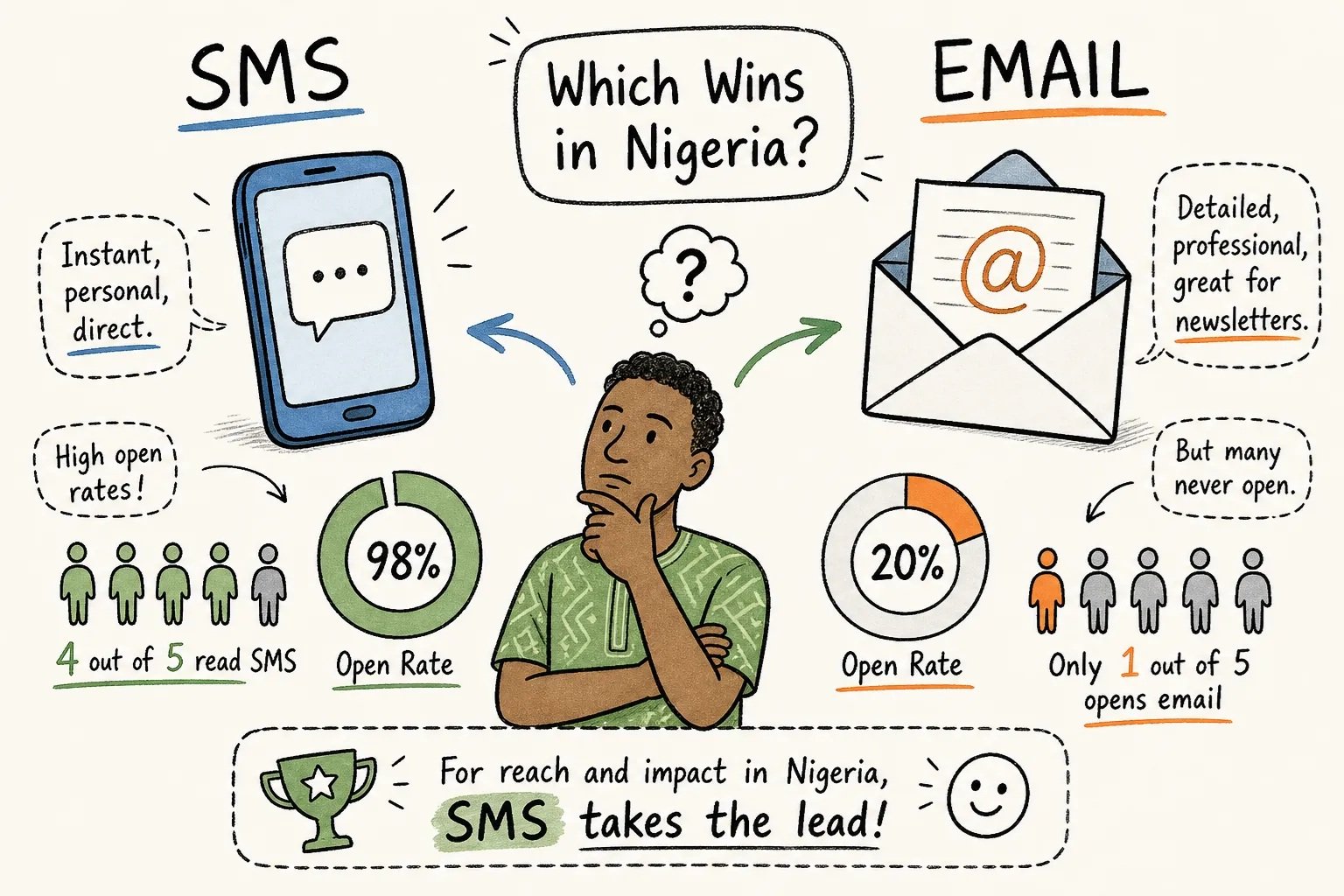
Which bulk SMS provider has the best bulk SMS delivery rates in Nigeria? It is the question every marketer and developer should answer before paying for a single credit. You budget for 10,000 messages, pay for 10,000 messages, and 1,500 of them never arrive. No error notification. No refund offer. Just a quiet failure that nobody warned you about before you pressed send. The gap between what a bulk SMS provider promises and what your recipients actually receive is one of the most under-discussed problems in Nigerian digital marketing, and it costs businesses real money every single day.
Here is the uncomfortable truth about the Nigerian bulk SMS industry: there are no independent, third-party delivery rate audits. Every “99.9% delivery guarantee” you see on a provider’s website is a self-reported marketing figure. This does not mean every provider performs equally. It means the responsibility falls on you to choose a platform that gives you the tools to verify delivery yourself, rather than simply asking you to take their word for it.
Nigeria Bulk SMS has been processing SMS traffic for Nigerian businesses since 2008, and every message sent through the platform generates a real-time delivery report you can inspect immediately after a send. That transparency is not accidental, it is what 17 years of operating in a demanding market teaches you to build. This article covers what good delivery performance actually looks like on Nigerian networks, why messages fail, and how to evaluate any provider before you commit your campaign budget to them.
What a good bulk SMS delivery rate actually looks like on Nigerian networks
MTN typically achieves 98% or above delivery success for properly routed A2P (Application-to-Person) bulk SMS. Glo, Airtel, and 9mobile generally average between 94% and 96% when traffic is routed correctly and contact lists are clean. These figures are not guarantees; they are the realistic ceiling that a competent provider should be hitting consistently, not occasionally.
A delivery rate below 95% across any Nigerian network is not a telco problem. It almost always points to issues with list quality, routing class, or compliance on the provider’s side. A failure rate of 5% or below is the accepted industry threshold. Anything above that signals a structural problem that better routing or list hygiene could fix.
How delivery rates are actually measured
Delivery rate is the percentage of messages that return a confirmed “Delivered” status from the recipient’s network handset, not merely messages that left the sender’s gateway. This distinction matters enormously. Many providers report their gateway submission rate, meaning how many messages their platform passed upstream, and present that figure as their delivery rate. Those are two entirely different measurements. For a broader industry perspective on how delivery rates are calculated and reported, see Messente’s analysis on SMS delivery rates for useful context: SMS delivery rate benchmarks and explanation.
The standard delivery statuses you should expect to see in any serious platform’s reporting are: Delivered, Pending, Expired, and Failed/Rejected. A “Pending” status means the message reached the network but has not yet been confirmed at the handset, often because the subscriber’s phone is off or out of coverage. “Expired” means the network’s store-and-forward window closed before delivery could be confirmed. “Failed/Rejected” is an immediate terminal state, usually caused by an invalid number, a blocked sender ID, or a content filter trigger. Each status tells a different story about where in the journey your message dropped. The technical behaviour of delivery receipts is specified in SMPP delivery receipt documentation, which explains how platforms receive and present per-message confirmations: SMPP delivery receipt details.
Why bulk SMS fails to deliver on Nigerian networks
The NCC’s Do Not Disturb (DND) framework is the single largest structural delivery barrier for promotional SMS in Nigeria. Millions of subscribers are registered on the DND list, and promotional messages sent to those numbers are silently dropped by the network before they reach the handset. There is no bounce notification, no failed status from the network’s perspective, the message simply disappears. A provider without a dedicated transactional route that is DND-exempt will lose a significant portion of any promotional campaign without the sender knowing why. For a detailed breakdown of common delivery failures and how to address them, see the guide: 10 Reasons Your Bulk SMS Doesn’t Deliver in Nigeria (And How to Improve SMS Delivery Rates).
Sender ID registration is mandatory on all major Nigerian networks. MTN, Airtel, Glo, and 9mobile block messages from unregistered or unapproved sender IDs as an anti-fraud and anti-spoofing measure. If your provider submits traffic under a sender ID that has not been formally approved by the network, those messages are blocked at the carrier level before delivery is even attempted. This is a compliance failure on the provider’s side, not a network quirk.
List quality, routing class, and network-level failures
Invalid or inactive numbers return immediate failure codes, and they inflate your failure rate fast if your contact list has not been properly cleaned. Common problems include disconnected SIMs, wrong number formats, and missing country codes. Before any large campaign, your contact list should be validated for correct Nigerian number formats, whether in the 080, 081, 070, or 090 range, or their international equivalent starting with 234.
Grey routes are the hidden delivery killer that cheaper providers rarely disclose. A grey route is a non-A2P routing path used to cut costs by disguising business traffic as person-to-person messages. Nigerian telcos actively detect and throttle grey route traffic, particularly during high-volume periods. A provider using grey routes may show decent delivery figures during off-peak hours but perform badly during a peak-hour campaign. Industry resources explain what grey routing is and why it degrades delivery: what is an SMS gray route. Direct A2P routing agreements with the networks are what separate tier-one providers from resellers cutting corners on cost.
Temporary failures, such as subscribers with phones switched off, memory full, or outside coverage, are handled differently by different providers. A good provider holds these messages in a store-and-forward queue and retries automatically for 24 to 48 hours. A poor provider marks them failed and moves on, which understates the platform’s delivery capability and costs you money on messages that could have been delivered.
Which bulk SMS provider has the best delivery rate in Nigeria? Start by ignoring their claims
The absence of independent audits in the Nigerian SMS industry is not a minor detail. It means every “industry-leading delivery rate” claim on every provider’s website is marketing copy, not a verified benchmark. This is not unique to Nigeria, it is a global pattern in the bulk SMS industry. What it means practically is that you cannot make a provider selection based on the number on their homepage.
The practical question to ask any provider is not “what is your delivery rate?” The right question is: “Can I see my delivery report broken down by network and status in real time, immediately after I send?” That one question separates providers who have the infrastructure to be transparent from those who do not.
What to look for instead of marketing claims
Real-time delivery reports that show per-message status across MTN, Airtel, Glo, and 9mobile separately are non-negotiable. Aggregated figures hide network-specific failures. If one network consistently underperforms for your traffic and the dashboard shows you only a combined average, you cannot identify or fix the problem.
SMPP and HTTP API support with delivery receipt callbacks allows developers to verify every message outcome programmatically, without relying on a dashboard figure. Before any large campaign, run a self-test: send a batch of messages to numbers you personally control on each of the four major networks, then track delivery time and status for each one. Any serious provider makes this process straightforward. A provider that makes it difficult to run test sends is telling you something important about how they handle transparency.
Nigeria’s top bulk SMS providers: a practical delivery comparison
What separates a tier-one provider from the rest
Tier-one providers maintain direct A2P routing agreements with MTN, Airtel, Glo, and 9mobile. These agreements give them stable, prioritised delivery paths and faster throughput than providers who resell capacity through intermediaries. When network congestion hits at 8 PM on a weekday, direct A2P agreements determine whose traffic gets through first.
The baseline features a reliable provider must offer are: transparent per-message delivery reporting, registered sender ID management, separate DND-compliant routes for transactional versus promotional traffic, and automatic retry logic for temporary failures. These are not premium add-ons; they are the minimum standard for a platform worth using.
Longevity in the Nigerian market also matters in a way that is hard to quantify but easy to understand. A provider that has navigated more than a decade of NCC regulatory changes, telco routing policy shifts, and infrastructure upgrades has demonstrated something a two-year-old startup simply cannot match: proven adaptability under real market pressure.
Nigeria Bulk SMS: 15+ years of verified delivery history
Nigeria Bulk SMS has operated since 2008, making it one of the longest-running bulk SMS platforms in the Nigerian market. Over those years, the platform has adapted to every major regulatory change the industry has seen, from the formalisation of sender ID registration to the NCC’s DND framework rollout. That institutional knowledge is built into how the platform routes traffic today.
Every message sent through Nigeria Bulk SMS generates a real-time delivery report showing network, delivery status, and timestamp. You do not have to take the platform’s word for it; the data is there in your dashboard after every send, broken down per message. For developers, both HTTP and SMPP API integration are supported, with delivery receipt callbacks via callback URL so your application can receive and log delivery confirmations automatically.
DND-compliant transactional routes are maintained separately from promotional routes. This separation is critical for OTP delivery, financial alerts, and any message where delivery failure has a direct operational consequence. Naira-based billing and 24/7 local support remove the friction that international platforms routinely create for Nigerian businesses.
Other providers worth evaluating
Several other platforms operate in the Nigerian market, including BulkSMSNigeria, MultiTexter, EBulkSMS, and Africa’s Talking. Most support sender ID customisation and offer some form of delivery reporting. The evaluation standard remains the same regardless of which platform you are assessing: can you verify delivery by network in real time, can the provider demonstrate direct A2P routing, and does the platform have a track record long enough to be meaningful? Newer entrants often compete on unit price, but a lower per-SMS cost offers no protection against grey routing failures or unregistered sender ID blocks at the carrier level. For a quick comparison of notable local providers, see this roundup of best bulk SMS providers in Nigeria.
If you need concrete use-case guidance rather than a vendor list, read Industries That Benefit Most From Bulk SMS (And How They Can Maximize Results) for examples of how different sectors use SMS effectively.
Choosing the right provider for your specific use case
OTP and transactional SMS: where delivery failure has a real cost
For OTP delivery, a failed or delayed message is not just a statistic. It breaks a login flow, blocks a payment confirmation, or locks a user out of an account at the exact moment they need access. Sub-second delivery speed and dedicated transactional routes that bypass DND filtering are mandatory requirements, not preferences. The route that carries your marketing campaigns cannot be the same route carrying authentication codes; the risk profile is entirely different.
Providers must support automatic retry logic for temporary failure codes, specifically subscriber-absent and network-congestion codes, and must keep OTP traffic separated from promotional traffic to avoid carrier spam filter contamination. Test delivery speed during peak hours, between 7 PM and 9 PM on weekdays, when Nigerian network congestion is highest. That is the real stress test. A provider that delivers in under five seconds during off-peak hours but takes three minutes during peak hours is not suitable for OTP use cases.
Promotional and marketing campaigns: volume, compliance, and cost
For promotional SMS, DND list segmentation is the primary delivery lever. Sending promotional content to DND-registered numbers is both a compliance breach and a waste of your SMS budget, because those messages are blocked before reaching any recipient. Any credible provider should let you preview what percentage of your contact list is DND-registered before you send, so you can make an informed decision about reach and cost.
Sender ID approval takes time, and the timeline varies by network. A provider worth using will have a clear, documented sender ID registration process and will confirm approval per network before your campaign goes live. At high volumes, the provider’s throughput capacity is a practical concern: a platform that throttles sends at 10,000 messages per hour will turn a 100,000-message campaign into a multi-day operation. Confirm throughput limits in writing before committing to a large campaign.
Which bulk SMS provider has the best delivery rate in Nigeria? Make your decision on data, not marketing
Delivery rates in Nigeria vary by network, use case, routing class, and contact list quality. No provider’s self-reported figure can substitute for real-time delivery data you can audit yourself after every send. The 99.9% claim on a homepage tells you nothing; the breakdown of Delivered, Pending, Expired, and Failed statuses across MTN, Airtel, Glo, and 9mobile in your dashboard tells you everything.
When evaluating which bulk SMS provider delivers the highest delivery rate in Nigeria for your use case, it comes down to three things: proven direct A2P routing on Nigerian networks, transparent per-message delivery reporting you can inspect yourself, and a track record long enough to demonstrate genuine reliability under changing market conditions. If you’re comparing channels as well as vendors, this piece on Bulk SMS vs Bulk WhatsApp Marketing in Nigeria outlines why SMS remains the most reliable choice for critical notifications.
Nigeria Bulk SMS is the starting point for businesses that need delivery they can actually verify. With over 17 years of continuous operation, naira billing, separate transactional and promotional routes, and real-time reporting available on every send, the platform is built for the realities of the Nigerian SMS market. Create a free account and run your first test send today. The delivery report will show you exactly what you need to know.