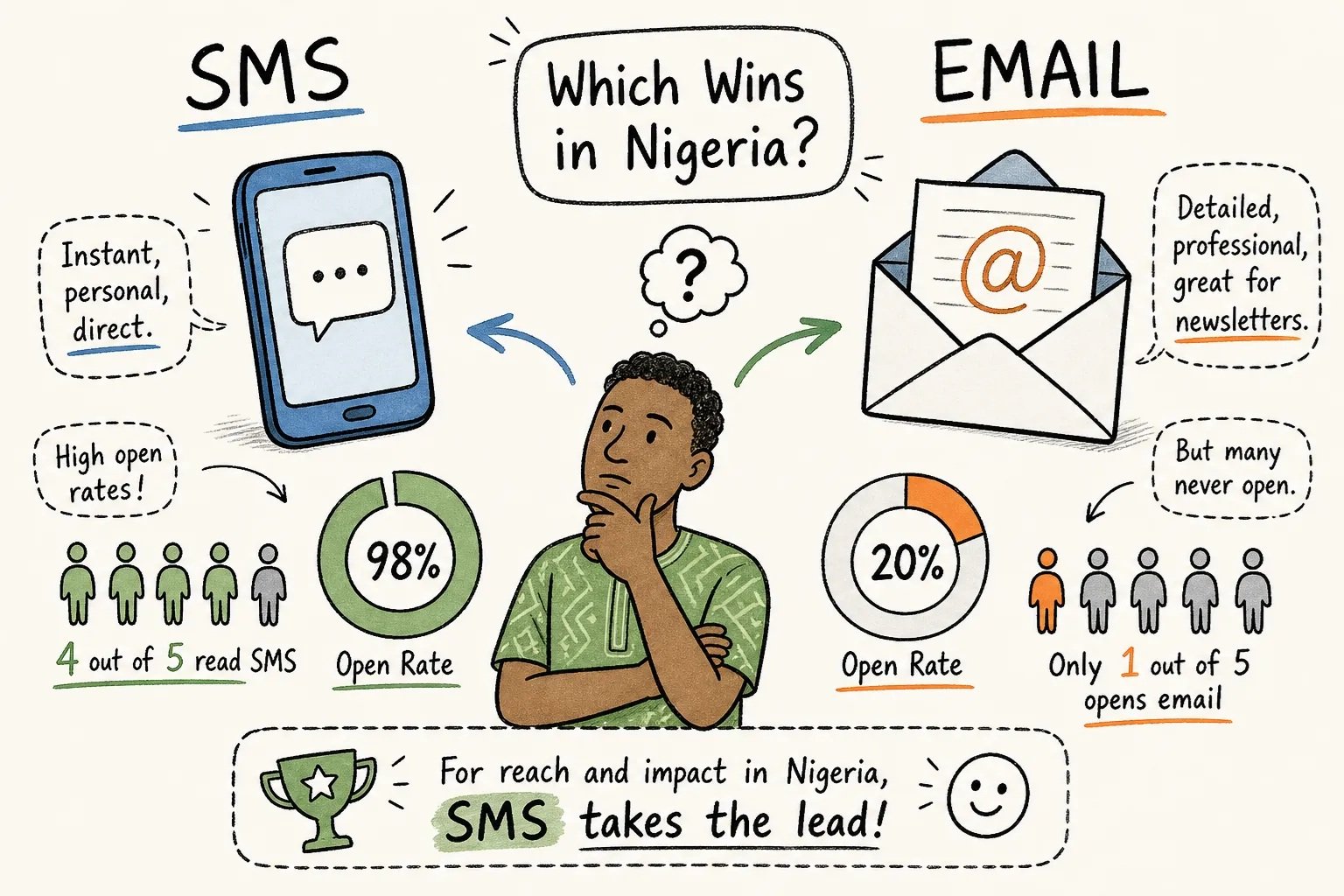
Is SMS marketing more effective than email for Nigerian customers? It is a question every Nigerian marketer faces at some point: you have a message to send, a budget to protect, and two channels sitting in front of you. One works on any phone with a SIM card. The other needs a smartphone, a data connection, and a customer who actually checks their inbox. In Nigeria, those are not equal conditions, and treating them as if they are will cost you reach, revenue, and credibility.
Nigeria Bulk SMS has been delivering messages for businesses across Nigeria since 2008. Years of campaign data across industries, geographies, and audience types have shaped a clear picture of how Nigerians actually respond to messages. This article does not transplant a global comparison into a Nigerian context; it is built from Nigerian benchmarks, Nigerian infrastructure, and Nigerian consumer behaviour, drawing on NCC guidance, industry benchmark data, and commercial pricing from licensed aggregators operating in the Nigerian market. By the end, you will have the performance numbers, cost comparisons, compliance requirements, and a practical decision framework to choose SMS, email, or both for your next campaign.
Why Nigeria’s mobile landscape reshapes the SMS vs email comparison
The basic phone reality and what it means for reach
Smartphone penetration in Nigeria sits at approximately 66% in 2026, which sounds high until you flip it: roughly a third of Nigerian mobile subscribers are still on feature phones. Network data reinforces this from a different angle. 2G connections account for 36% of all mobile connections as of mid-2026, with 2G and 3G combined exceeding 41%. Feature phones operate natively on these networks, receive SMS without any additional configuration, and cannot render HTML emails, access Gmail, or load marketing links without mobile data.
For any brand trying to reach customers across Lagos, Kano, Aba, Enugu, and the towns in between, SMS is the most reliable channel for landing a message on every device class. Email requires a smartphone, an email client, and an active connection at the moment of opening. SMS requires none of those. That single infrastructure difference shapes every performance comparison that follows.
Internet dependency and what it does to email delivery
Mobile internet access in rural Nigeria sits at approximately 23% to 45%, depending on the measurement source, while urban centres report access rates of 57% to 85%. An email sent at 10 a.m. on Tuesday to a customer in Onitsha or Sokoto may not be seen until Friday evening, if at all. This is an illustrative but plausible scenario: intermittent connectivity, low handset storage, and variable data access are documented features of rural Nigerian mobile usage. A delay of several days is not a minor inconvenience for time-sensitive campaigns; it renders the message irrelevant before it is even opened.
SMS bypasses this problem entirely. A message delivered through a reliable SMS gateway surfaces a notification on the handset regardless of internet status. The customer sees it on the lock screen, within minutes of sending, whether they are on 2G in a rural market or 4G in Victoria Island. That reliable delivery window is the foundation on which every other performance metric is built.
Is SMS more effective than email for Nigerian customers? The numbers
SMS performance benchmarks in Nigeria
SMS open rates in Nigeria sit between 90% and 98%, with opt-in lists consistently reaching the higher end of that range. These figures are consistent with industry benchmarks from licensed Nigerian aggregators and NCC-aligned operator data. Click-through rates average 6% to 8% on warm lists; engaged, segmented audiences reach 9% to 14%, while cold or poorly maintained lists return 3% to 6%. Internal campaign data from Nigerian bulk SMS operators shows that well-structured promotional SMS campaigns have returned conversion uplifts of 20% to 30% within the first quarter, results that few digital channels match at comparable cost.
The reason these numbers hold up is structural. SMS delivers to the lock screen, is read within minutes of receipt, and requires no internet connection to open. There is no spam folder, no promotions tab, and no algorithm deciding whether your message gets shown, though it is worth noting that network-level DND filtering and unregistered sender IDs can affect deliverability, which is why compliance and proper sender registration matter. When you send through a quality, compliant route, your message arrives and your customer sees it.
Email benchmarks for Nigerian campaigns
Nigerian consumer email campaigns on well-maintained opt-in lists typically return open rates of 30% to 35%. Fintech and retail sectors land within that band, with segmented fintech lists reaching 33% to 38% in some campaign reports from Nigerian market operators. Click-through rates average 2% to 2.5%, and conversion rates for typical e-commerce or lead-generation campaigns sit between 0.1% and 1%. These are not weak numbers in isolation, but they look very different placed alongside SMS benchmarks.
Apple Mail Privacy Protection inflates open-rate figures across platforms, meaning reported opens are higher than actual engagement. Real interaction, measured by clicks and conversions, is lower than open rates suggest. For Nigerian campaigns, where many email clients are accessed on mobile devices with inconsistent connectivity, the gap between opens and genuine engagement is wider than global averages indicate, a caveat worth building into any email channel forecasts.
What the gap means for your campaigns
Send 10,000 messages via SMS and roughly 9,800 recipients see your message. Send to a comparable email list and roughly 3,200 open it. Of those, between 64 and 80 will click through. For time-sensitive offers, OTP delivery, appointment reminders, payment notifications, or flash sales, the arithmetic heavily favours SMS. Every hour of delay in email delivery is an hour in which a customer can buy elsewhere, forget the offer, or lose interest entirely.
Email becomes genuinely competitive when nurturing long-form content, sending detailed product catalogues, or reaching urban professionals who actively manage inboxes on smartphones. A retailer running a flash sale via SMS while reserving the full product catalogue email for follow-up will consistently outperform one who splits randomly between channels. The two channels serve different moments in the customer journey, and matching the right channel to the right moment is where campaigns win or lose.
Cost per contact and where your naira goes further
What SMS actually costs in Nigeria
Standard SMS pricing in Nigeria runs at approximately ₦7 per message at typical commercial rates, with high-volume enterprise routes reducing that to ₦6 per message. For a campaign of 10,000 messages at ₦6 per SMS, total spend is ₦60,000. At a 98% open rate and a 7% click-through rate, that delivers 700 engaged clicks. Compared to email delivering 64 to 80 clicks from the same list size, the cost per engaged contact via SMS is substantially lower, even at standard pricing.
Volume pricing improves these numbers further. Businesses running regular campaigns at scale through SMS platforms typically benefit from reduced per-unit rates, details are available on provider pricing pages, and Nigeria Bulk SMS publishes its volume rate tiers directly. This strengthens the ROI case for SMS as the primary performance channel, particularly for promotions and transactional messaging where speed and reliable delivery directly affect revenue.
Email cost structure and when it earns its keep
Email’s cost model is subscription-based rather than per-send, meaning the incremental cost per contact approaches zero once the platform plan is paid. For large, engaged lists in urban markets where smartphone penetration and internet access are reliable, this makes email highly cost-efficient at scale. A nurture sequence or monthly newsletter sent to 50,000 subscribers costs roughly the same as one sent to 5,000, an advantage SMS per-unit pricing does not offer.
The trade-off is the investment required to build and maintain a deliverable Nigerian email list. Platform subscription fees, design and copywriting overhead, deliverability maintenance, and consistently lower engagement rates can erode the per-send cost advantage faster than the headline numbers suggest. Email earns its keep for specific segments and use cases; it is not the default channel for broad Nigerian audience reach.
Compliance rules you cannot ignore in 2026
NCC’s DND framework, sender ID registration, and anti-spam rules
The Nigerian Communications Commission regulates commercial SMS under the Nigerian Communications Act 2003 and the International A2P Messaging Aggregator Service Licence framework. Any business sending promotional SMS must respect the NCC’s Do-Not-Disturb service, reachable on the short code 2442, and must filter all sends against opted-out numbers before every campaign. Sending promotional messages to DND-registered numbers is a compliance violation, not a delivery anomaly.
Alphanumeric sender IDs must be registered and approved before campaigns go live. The registration process involves submitting your CAC certificate, a signed application on company letterhead, sample message content, and your intended use case to an NCC-licensed aggregator, who then files the request with MTN, Airtel, Glo, and 9mobile separately.
Each network reviews applications independently, and approval typically takes one to five business days once documentation is complete. Unregistered sender IDs are blocked by network operators, meaning your messages will not reach recipients at all if you skip this step. Factor that lead time into any campaign planning that depends on a new sender name.
Opt-in obligations, data protection, and record-keeping
Both SMS and email marketing in Nigeria require explicit consumer consent to receive promotional messages. The NCC framework prohibits unsolicited, random, or untargeted SMS entirely, and service providers must not send, or arrange for others to send on their behalf, any unsolicited commercial message. This is a legal obligation, not a recommendation. Beyond NCC rules, commercial senders must also comply with Nigeria’s data protection obligations governing how contact data is collected, stored, and used.
Message records must be stored by the service provider for a minimum of six months. Transactional messages such as OTPs, payment confirmations, and system alerts receive different treatment from promotional traffic but still require approved sender IDs and compliant routing. The practical compliance steps are straightforward: obtain documented opt-in before sending, register your sender ID through a licensed aggregator, filter your list against DND numbers before every campaign, and retain records of all send activity.
SMS, email, or both: how to build the right strategy
When SMS is the clear choice for Nigerian mobile marketing
SMS wins when reach and speed matter most. Flash sales with 24-hour windows, OTP and transaction alerts, appointment reminders, payment notifications, and any campaign targeting audiences in areas with limited smartphone or internet access all belong in the SMS column. For small and medium-sized Nigerian businesses reaching a broad geographic audience, SMS is the default channel, not because email lacks merit, but because email requires infrastructure conditions that do not exist uniformly across Nigeria’s 36 states. This is the core of what makes SMS marketing effective for Nigerian customers at scale.
When email adds genuine value
Email earns its place for nurture sequences aimed at urban professionals, detailed product announcements requiring images and structured formatting, long-form newsletters, and re-engagement campaigns for dormant customers who previously opted in through a digital touchpoint. If your audience is predominantly smartphone-equipped and internet-active, email can deliver strong ROI at negligible marginal cost per send, particularly for content-heavy campaigns where a 160-character SMS would not do the message justice.
Building a combined SMS and email sequence
The most effective approach for Nigerian businesses with mixed audiences is a sequenced combination. Use SMS for the first-touch alert or time-sensitive nudge, then follow with email for detail, documentation, or post-purchase nurture. Send an SMS announcing a sale with a short link; follow up with an email containing the full product catalogue to recipients who clicked. This SMS and email automation approach, triggering the follow-up email based on the SMS click, respects your audience’s device and connectivity reality while maximising the information depth that email enables. In mobile marketing for Nigeria, where 2G/3G segments are substantial, testing message routes across network types will sharpen delivery outcomes further.
Keep SMS messages concise, action-oriented, and compliant with NCC rules. Reserve email for moments when the reader has the bandwidth and device to engage with richer content. The combination is about matching the right channel to the right moment in the customer’s journey, which is what drives measurable results rather than vanity metrics.
Which channel should you start with?
Which is more effective in Nigeria, SMS or email? For most Nigerian businesses, SMS outperforms email on the primary engagement metrics that drive revenue: open rates, immediate click-through, and cost per engaged contact. It works on every phone class, without internet dependency, and delivers to the lock screen within minutes. For businesses reaching audiences across the full geographic and economic range of Nigeria, SMS is not simply more effective; for the significant share of customers on feature phones or with unreliable data access, it is often the only channel that reliably reaches the customer at all. A 90%-to-98% open rate is not a marketing claim, it is what happens when a message arrives on a device without requiring a data connection to surface it.
Email remains valuable for specific segments and use cases, particularly in urban, smartphone-heavy audiences where inbox management is an active habit. For long-form nurture and content-rich campaigns, email can be more cost-efficient over time. The combined-channel approach, SMS as the first-touch and email as the follow-through, is the strongest long-term strategy for businesses serving Nigeria’s diverse, geographically spread customer base.
The practical next step is to start with a segmented SMS send through Nigeria Bulk SMS, measure your open and conversion rates against the benchmarks in this article, and build your email layer on top of the SMS foundation you have already established. Nigeria Bulk SMS handles sender ID registration, DND filtering, and campaign setup, the mechanics this article has outlined, so your first send can go live within a few business days. The data here tells you what to expect; your campaign results will tell you exactly where to optimise next.