A customer initiates a bank transfer. The app freezes on the OTP screen. Five seconds pass. Then ten. Then thirty. The code never arrives. That single moment costs the bank a support call, a frustrated complaint, and quite possibly a customer who switches to a competitor before the week is out. Transactional SMS in Nigeria is not a messaging feature you bolt on after launch; it is the trust infrastructure that regulated businesses stake their reputation on every day.
The stakes are different here compared to marketing messages. A promotional SMS that misses a DND-registered number is a missed sale. A payment alert that fails to deliver is a fraud liability. A hospital appointment reminder that disappears at the network level is a no-show and lost revenue. Getting transactional messaging right requires more than picking a provider and firing off API calls. It requires understanding how Nigerian networks classify traffic, how DND exemptions actually work, and what separates a reliable gateway from one that looks identical on a pricing page but performs very differently under load.
Nigeria Bulk SMS has been running transactional SMS delivery in this market since its founding, through every major network restructuring and NCC regulatory shift the industry has seen. This guide is written for business owners, developers, and compliance teams who want a clear picture of what transactional SMS is, how it behaves on Nigerian networks, and how to integrate it correctly from the start.
What transactional SMS actually is (and what it is not)
Transactional SMS is a message triggered by a specific user action or business event, sent to a recipient who already has an active relationship with the sender. It is not a broadcast. It is not a promotion. It is a direct, expected response to something the recipient did or needs to know. An OTP triggered by a login attempt, a debit notification after a card transaction, an order dispatch confirmation from an e-commerce platform, all of these are transactional messages. A flash sale announcement to your entire contact list is not, regardless of how you label it in your platform settings.
The distinction has real consequences for delivery, timing, and compliance. These two categories are treated differently at the network routing level, and misclassifying your traffic is one of the most common and costly mistakes Nigerian businesses make.
The clear line between transactional and promotional SMS
Promotional messages advertise products or services. They are subject to the 8:00 AM to 8:00 PM delivery window and are blocked from DND-registered numbers unless the recipient has given explicit consent. Transactional messages (OTPs, payment confirmations, account alerts, appointment reminders) are tied to a service the recipient actively uses and are authorised to deliver at any time of day, including to DND numbers, when correctly classified.
A hospital sending an appointment reminder operates under entirely different rules from a supermarket sending a weekend sale announcement, even if both are using the same SMS platform. What defines the classification is the content, the trigger, and the nature of the business relationship, not a checkbox you select during campaign setup.
Common mistakes businesses make with transactional routes
The errors that cause delivery failures are usually not technical; they are classification errors. Using a transactional route to push promotional content, mixing campaign messages with service alerts under the same sender ID, or failing to register the sender ID under the correct category are among the most common mistakes Nigerian businesses make. Mobile operators and their aggregators are increasingly strict about this, and the consequences are silent: a misclassified message does not always bounce with an error code. It simply does not arrive.
Troubleshooting a silent delivery failure is significantly harder than setting the integration up correctly from the beginning. The right time to get this right is before go-live, not after your OTP failure rate starts climbing.
Why Nigerian banks, fintechs, and healthcare providers depend on transactional SMS
For a fintech processing thousands of transactions per hour, transactional SMS is mission-critical infrastructure. Delivery failure is not a UX inconvenience; it is a potential fraud exposure, a compliance breach, and a customer retention problem all at once. Businesses that treat their SMS gateway as a commodity rather than a critical dependency tend to discover the difference at the worst possible moment.
OTPs, payment alerts, and account notifications in financial services
Nigerian banks and fintechs send high volumes of transactional messages daily, for institutions of significant size, that can mean millions of messages. Each two-factor authentication login, each debit notification, each transaction reversal confirmation depends on a message arriving within three seconds or less. Many premium providers advertise sub-3-second OTP delivery on priority routes, and first-attempt delivery latency is a critical KPI for both user experience and security. If an OTP expires before it arrives, the customer abandons the transaction or calls support. Both outcomes cost money, and at scale, both erode trust in the platform itself.
Regulated entities also face compliance expectations from the CBN that make reliable SMS delivery a governance issue, not purely an operational one. A bank that cannot demonstrate consistent OTP delivery, with documented delivery reports, is carrying compliance risk that extends well beyond customer experience. Sub-3-second OTP delivery on priority routes and documented uptime SLAs of 99.9% are not marketing embellishments, they are the minimum expectations for financial services integration.
E-commerce order updates and healthcare appointment reminders
For e-commerce platforms, transactional SMS fills a gap that email cannot reliably close. An order dispatch notification or a failed delivery alert sent via SMS reaches the customer immediately, without depending on them checking an inbox. Reported delivery rates on quality transactional routes in Nigeria typically sit between 97% and 99.8%, a figure that compares favourably to email channels where open rates in this market are frequently well below 30%.
In healthcare, a well-timed appointment reminder sent 24 hours before a consultation directly reduces no-shows and the revenue loss that comes with them. These are not marketing messages; they are service communications that customers expect. The reliability of the infrastructure underneath shapes each of those interactions, for better or worse.
How DND routing and NCC compliance shape transactional SMS delivery in Nigeria
Most Nigerian businesses get this section wrong, and it costs them. The NCC’s Do-Not-Disturb registry and sender ID rules are not bureaucratic details. They are the mechanism by which your message either reaches the customer or disappears at the network edge without explanation.
What DND exemption actually means for transactional traffic
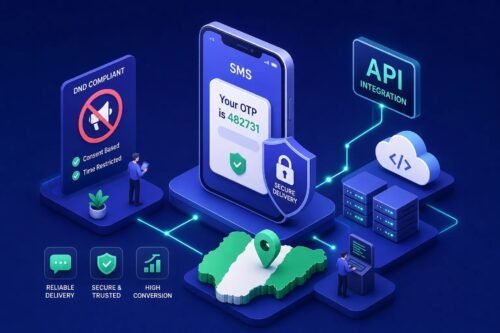
The NCC DND registry, activated by subscribers via the shortcode 2442, allows consumers to opt out of unsolicited commercial messages. Promotional SMS to a DND-registered number is blocked. Transactional messages, however, are generally exempt: OTPs, payment alerts, account notifications, and service messages can be delivered 24 hours a day, seven days a week, to numbers on the DND list, provided they are correctly classified and routed through an appropriate corporate or priority channel.
The critical nuance is that this exemption applies to genuinely transactional traffic, not to promotional content that has been funnelled through a transactional route. Nigerian mobile network operators enforce this at the routing level, and providers with NCC-aligned corporate routes can push transactional traffic through to DND-registered numbers. This is why the route type you select matters as much as the message content.
Sender ID registration and NCC-aligned compliance requirements
To send transactional SMS in Nigeria using a custom alphanumeric sender ID, for example, your company or brand name, that ID must be registered and approved through your provider’s NCC-aligned compliance workflow. Unregistered sender IDs may be converted to a generic numeric string or have messages dropped entirely, with no error returned to you; the exact behaviour can vary by operator.
The practical process involves applying through your SMS provider, submitting business documentation, specifying whether the sender ID is for transactional or promotional traffic, and waiting for approval before going live. Approval timelines vary by provider and network, so check with your provider for their current turnaround. One point that cannot be overstated: using an approved transactional sender ID to run a promotional campaign is a compliance violation that can result in the ID being suspended entirely. Classification is not interchangeable.
Integrating a transactional SMS gateway: API setup and choosing the right provider
The integration itself is straightforward once the route, sender ID, and classification are in order. The two key decisions are which API connection type suits your use case, and which provider gives you the reliability history to back up what they promise on their website.
HTTP API vs SMPP: choosing the right connection type
Most Nigerian SMS gateways offer two main API options. HTTP APIs, typically REST-based with JSON payloads, are the simplest to integrate for developers building web applications, fintech backends, or e-commerce platforms. You authenticate with an API key or bearer token, POST a payload containing your sender ID, the recipient number in international format (234XXXXXXXXXX), and the message body, then handle delivery reports via a callback URL or polling endpoint.
SMPP, the Short Message Peer-to-Peer protocol, is a persistent socket connection designed for high-throughput enterprise workloads. It carries lower per-message overhead, handles delivery receipts natively through asynchronous PDUs, and is the appropriate choice for businesses sending hundreds of thousands of OTPs per hour who need the lowest possible latency at sustained scale. For most Nigerian SMEs and mid-size fintechs, an HTTP API with a well-documented sandbox environment is sufficient. For banks processing millions of transaction alerts daily, the additional complexity of SMPP integration is worth it.
What to look for in a transactional SMS Nigeria provider beyond price
Price is one variable. The more important criteria are uptime history, route quality (DND-exempt corporate routes versus standard), sender ID support with correct classification, delivery reporting depth, and local technical support. A provider that has been operating in the Nigerian market for many years has lived through MTN and Airtel network restructuring, NCC A2P routing changes, and the evolution of stricter sender ID enforcement, and has adapted their infrastructure accordingly through each of those shifts.
Naira-based billing removes the currency conversion friction that comes with international providers, and responsive local support means you can escalate a delivery issue at 2:00 AM during a system-critical OTP failure without waiting for a foreign time zone to open. These are not minor conveniences. For a fintech running authentication flows around the clock, they are the difference between a one-hour incident and an eight-hour one.
Why Nigeria Bulk SMS is a dependable choice for transactional messaging
Nigeria Bulk SMS has been building and maintaining transactional SMS infrastructure in this market through every significant network change the industry has seen. The platform offers HTTP API integration with developer documentation, sandbox testing, and delivery reporting built into the standard offering, and SMPP connectivity is available for enterprise clients with high-throughput requirements; confirm specifics with the team directly. Businesses can send OTPs, payment alerts, and account notifications under a custom alphanumeric sender ID with DND-exempt routing on premium corporate channels.
All billing is in Nigerian Naira, keeping cost management predictable for local businesses and development teams. For organisations scaling up volume, the platform is designed to handle high-throughput transactional workloads; contact the team for SLA and throughput details relevant to your use case. It is a well-suited option for Nigerian fintechs, healthcare providers, and e-commerce operators seeking a dependable, locally rooted transactional SMS gateway. Sandbox access and sender ID registration are available through the Nigeria Bulk SMS platform before committing to production volumes.
Getting transactional SMS right in Nigeria protects more than your delivery rate
Transactional SMS in Nigeria is not a commodity. It is regulated infrastructure that requires the correct route type, a registered and properly classified sender ID, and a provider with the reliability history and local presence to back up their delivery claims. Getting this right protects your customers, your brand, and your compliance standing simultaneously.
Whether you are a fintech sending 50,000 OTPs a day or a clinic reminding 200 patients about upcoming appointments, the gateway underneath that experience shapes the quality of each interaction. The wrong choice reveals itself at the most inconvenient moment: during peak transaction hours, during a system audit, or when a customer’s critical message simply never arrives.
Nigeria Bulk SMS combines local delivery experience, HTTP and SMPP API options, Naira-based billing, and DND-exempt corporate routing into a single platform built specifically for the Nigerian market. Start with a sandbox test, register your sender ID under the correct classification, and move to production with confidence that the infrastructure underneath you has been serving this market through its most demanding periods.
Frequently asked questions about transactional SMS in Nigeria
What is transactional SMS in Nigeria?
Transactional SMS in Nigeria refers to messages triggered by a specific user action or business event, such as an OTP, a payment confirmation, or an account alert, sent to a recipient who has an existing relationship with the sender. Unlike promotional SMS, transactional messages are exempt from time-of-day restrictions and can be delivered to DND-registered numbers when correctly classified and routed.
Can transactional SMS reach DND-registered numbers in Nigeria?
Yes, provided the message is genuinely transactional and is routed through an NCC-aligned corporate or priority channel. The DND exemption covers service communications such as OTPs, payment alerts, and account notifications. It does not cover promotional content dressed up as transactional traffic, operators enforce this distinction at the routing level.
How does OTP SMS in Nigeria work on priority routes?
OTP SMS in Nigeria is sent via a transactional SMS gateway on a priority or corporate route that bypasses standard queue delays and DND restrictions. Premium providers aim for sub-3-second delivery on these channels. The sender ID must be registered as transactional, and the message must be triggered by an identifiable user action such as a login attempt or payment initiation.
What is the difference between an HTTP API and SMPP for a transactional SMS gateway in Nigeria?
An HTTP (REST) API is easier to integrate and suits most web applications, fintech backends, and e-commerce platforms. SMPP is a persistent socket protocol designed for very high-throughput scenarios, typically banks or platforms dispatching hundreds of thousands of messages per hour, where lower per-message latency and native asynchronous delivery receipts justify the added integration complexity.
What are typical SMS delivery rates on quality transactional routes in Nigeria?
Reported delivery rates from providers offering premium transactional routes typically range between 97% and 99.8%. Achieving the upper end of that range requires correct message classification, a registered sender ID, and a gateway with NCC-aligned corporate routing. Always request delivery report access and run sandbox tests before committing to production volumes.
How do I register a sender ID for transactional SMS in Nigeria?
You apply through your SMS provider, submit the required business documentation, and specify that the sender ID is for transactional use. The provider submits this to the relevant operators for approval. Timelines vary, check with your chosen provider for current turnaround expectations. Using an approved transactional sender ID for promotional campaigns is a compliance violation and can result in suspension of the ID.
How do I choose among bulk SMS providers in Nigeria for transactional traffic?
Evaluate providers on route quality (DND-exempt corporate routing), delivery reporting depth, uptime SLAs, local support availability, sender ID classification support, and Naira-based billing. Price per message matters, but a lower rate on a poor-quality route will cost more in failed deliveries and incident resolution than a slightly higher rate on a proven premium channel.