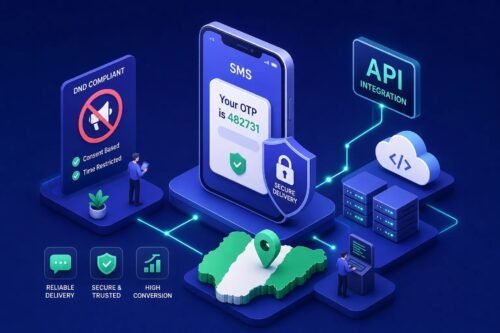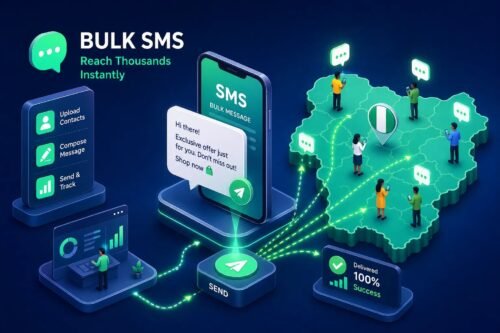
How can US businesses send bulk SMS to customers in Nigeria? The answer is more structured than a typical domestic campaign, but entirely manageable with the right platform and a clear pre-launch checklist. US businesses can send bulk SMS to Nigerian customers by selecting a provider with approved A2P routes to all four major Nigerian networks (MTN, Airtel, Glo, 9mobile), registering a branded sender ID, formatting recipient numbers in E.164 international format, and suppressing DND-registered contacts before every campaign send. Nigerian requirements, including per-network sender ID approvals, mandatory DND checks before each send, and NDPA 2023 obligations, make the process more involved than sending to US numbers, but none of these steps are technically complex once you know what each one demands.
This guide walks through provider selection, number formatting, NCC regulatory compliance, per-network delivery considerations, cost estimates in both USD and Naira, and a practical step-by-step workflow for both dashboard and API users. By the end, you will have enough to choose the right route, budget accurately, and send your first compliant campaign to Nigeria.
Key takeaways
- Provider choice is critical: Many Nigerian-focused gateways handle A2P routing, sender ID registration, and DND filtering as built-in features. Verify these capabilities with any provider before signing up, as global CPaaS platforms may offer the same features but require explicit configuration or separate contract terms.
- Number format matters: Convert all Nigerian numbers from local format (e.g. 08012345678) to E.164 (2348012345678) before uploading any contact list.
- Start sender ID early: Registration across all four networks takes two to four weeks; begin this process well before your intended campaign date.
- DND suppression is mandatory: Promotional SMS must be filtered against Nigeria’s DND registry (short code 2442) before every single send, not just once at setup.
- Watch segment count: A 240-character GSM-7 message bills as two segments (since concatenated segments use approximately 153 characters each, not the standard 160); emoji or Unicode characters reduce the per-segment limit from 160 to 70 characters, fragmenting even short messages quickly.
- NDPA 2023 applies to you: Foreign companies holding Nigerian phone numbers for marketing must meet Nigeria’s data protection obligations, including lawful basis and consent records.
How can US businesses send bulk SMS to customers in Nigeria: choosing the right provider
Nigerian-focused platforms versus global CPaaS: the real difference
Global CPaaS platforms such as Twilio, Infobip, Sinch, and Vonage all list Nigeria as a supported destination, but they treat it as one entry in a 200-country catalogue. Twilio, for example, publishes $0.3868 per segment for Nigerian numbers, and Infobip’s indicative list price runs $0.30 to $0.40 per SMS. These platforms also tend to offer limited visibility into per-network routing. Buyers should confirm whether each CPaaS vendor supports per-network routing, handles sender ID registration across all four Nigerian carriers, and includes DND suppression as a standard workflow step rather than an optional integration, these capabilities vary significantly between providers and are not always apparent from published documentation.
A Nigerian-dedicated SMS gateway maintains direct A2P connections to MTN, Airtel, Glo, and 9mobile. It submits sender ID applications per network, enforces DND filtering as a standard part of every send, and prices messages at rates that reflect local carrier agreements. Nigeria Bulk SMS has an established track record of delivering international bulk text messaging to Nigeria on all four major networks, with card-based billing that removes the need for a Naira bank account, a practical advantage for US senders. Verify current payment options and onboarding terms directly with the provider before committing.
What to confirm before signing up with any provider
Before committing to any platform, work through this checklist:
- Explicit A2P coverage on MTN, Airtel, Glo, and 9mobile
- Sender ID registration support for non-Nigerian companies
- Card-based or USD payment options
- Delivery-report webhooks (callback URLs)
- DND filtering built into the standard send workflow
- A documented policy for crediting failed messages
Running through this checklist before you sign up prevents the common and costly mistake of discovering a coverage gap only after a campaign has already been sent.
How do you format Nigerian numbers and register a sender ID?
Converting local numbers to E.164 international format
Nigerian local numbers begin with a leading zero: 08012345678. To send international SMS to Nigeria from the US, replace the leading zero with the country code 234, giving 2348012345678. Uploading a CSV with the original local-format numbers may result in the batch being rejected or misrouted, depending on how the platform validates input, test your provider’s behaviour with a small file before processing a full list. Before upload, also remove landlines, duplicates, and numbers with incorrect digit counts; all three inflate your billing without producing any delivery.
The sender ID registration process and what carriers actually require
An alphanumeric sender ID in Nigeria is capped at 11 characters and must clearly identify the business. Carriers reject generic labels such as “ALERT” or “INFO” and require company documentation, a website, a use-case description, and sample messages for each intended campaign type. Approval on one carrier does not extend automatically to the other three, so your provider must submit and track registrations separately for MTN, Airtel, Glo, and 9mobile. Plan for approximately two to four weeks across all networks, with 9mobile typically approving in three to seven working days and Glo taking up to fifteen. Unregistered sender IDs are either overwritten with a generic label or blocked outright.
What does Nigerian SMS compliance actually require from a US sender?
NCC rules, DND suppression, and the opt-in obligation
Nigerian subscribers enrol in the NCC Do-Not-Disturb programme by texting STOP to short code 2442, and carriers filter promotional traffic for DND-enabled numbers at the network level. Scrub your list against the DND registry before each campaign send, not only at initial list setup. The NCC framework also requires affirmative opt-in consent for marketing SMS, with consent records capturing the recipient’s number, the date consent was given, the channel, and the campaign scope. Transactional messages such as OTPs, payment alerts, and appointment confirmations face lighter restrictions but must not contain any disguised promotional content. Restrict promotional sends to approximately 08:00 to 20:00 West Africa Time on weekdays.
Nigeria Data Protection Act 2023 and record-keeping requirements
The NDPA 2023 applies to any foreign company that processes personal data relating to people in Nigeria, including phone numbers collected for SMS marketing. A US business must establish a lawful basis for processing (consent for promotional campaigns), provide a privacy notice before or at the point of data collection, limit use to the stated purpose, handle data securely, and respond to data-subject access and deletion requests. The NCC’s international A2P framework makes NDPA compliance an obligation for overseas senders. Retain consent evidence, DND check logs, campaign content, delivery reports, and opt-out records for at least six months. If your business runs high campaign volumes or controls its own sending infrastructure, consult Nigerian communications counsel before launching.
How do delivery rates differ across MTN, Airtel, Glo, and 9mobile?
Per-network performance and the failure points that matter most
MTN consistently achieves the strongest delivery rates on approved A2P routes, with OTP messages commonly landing in three to eight seconds off-peak. Airtel is generally reliable but may impose tighter throughput limits per second depending on your account tier and aggregator terms, confirm these limits directly with your provider, as they are not always publicly disclosed. Glo performs well on direct routes but degrades more sharply on indirect or shared paths during peak hours. 9mobile carries the highest transient-failure risk of the four, requiring closer monitoring and more frequent retries than the other networks. Unregistered sender IDs, DND filtering, and incorrect message classification remain the most common failure causes across all four carriers, regardless of route quality.
Routing choices that reduce failures and delays
Four routing decisions have the greatest practical impact on delivery. Use direct A2P connections to each network rather than grey or shared routes. Perform Mobile Number Portability (MNP) lookups before submission so that ported numbers reach the correct current network. Keep promotional and transactional traffic on separate route types because mixing them risks filtering across all carriers. Implement delivery-report-driven retries for temporary failures such as congestion or unreachable handsets, but do not retry permanent rejections like invalid numbers or DND blocks. For OTP traffic specifically, apply a 15-second delivery-report timeout before attempting a secondary route.
What does it cost to send bulk SMS to Nigeria?
Typical per-SMS price ranges in NGN and USD across different volumes
The table below covers planning ranges for one-segment GSM-7 messages. Naira figures use an illustrative rate of ₦1,500 per USD and should be recalculated using the prevailing exchange rate at the time of purchase.
| Volume tier | Typical USD per SMS | Illustrative NGN per SMS | Notes |
|---|---|---|---|
| Small (1,000–10,000) | $0.03–$0.06 | ₦45–₦90 | Standard pay-as-you-go rates; no volume discount |
| Medium (10,000–100,000) | $0.02–$0.04 | ₦30–₦60 | Tiered pricing typically begins at this level |
| Large (100,000+) | $0.01–$0.03 | ₦15–₦45 | Negotiated rates; confirm with provider directly |
Nigerian-focused providers like Nigeria Bulk SMS publish a flat per-SMS rate in Naira (currently ₦6.49 per page before VAT), which makes budgeting straightforward and removes currency conversion uncertainty. Global CPaaS providers quote in USD and add carrier surcharges on top, pushing effective rates for bulk text messaging to Nigeria significantly higher than their headline figures suggest. Always verify current pricing directly with each provider before building your campaign budget.
The factors that inflate the real cost beyond the advertised rate
Four cost multipliers are worth understanding before you build a campaign budget. Message segmentation is the biggest: a 240-character GSM-7 message splits across two segments (concatenated GSM-7 segments use approximately 153 characters each rather than the standard 160), doubling your per-message cost. Unicode encoding, triggered by emoji or non-standard characters, reduces the per-segment character limit from 160 to 70, fragmenting even short messages. Sender ID registration fees may be one-time or recurring per network depending on the provider. Some platforms also add DND filtering or compliance surcharges as a separate line item. Nigerian providers billing locally apply VAT at 7.5%, confirm whether any quoted rate is inclusive or exclusive of tax before committing funds, and check current tax rules with your provider.
Step-by-step: launching your first Nigerian bulk SMS campaign
Sending via the web dashboard and CSV upload
The practical dashboard workflow follows these nine steps in sequence:
- Create and verify your account, then fund the wallet via card.
- Submit the sender ID application and wait for network approval across all four carriers.
- Build your contact list in CSV format using E.164 numbers, keeping promotional and transactional recipients in separate files.
- Upload the CSV and allow the platform to validate, deduplicate, and remove invalid numbers.
- Select the approved sender ID and the correct route type (promotional or transactional).
- Compose the message, check the segment count, and preview any merge personalisation fields.
- Send a small test batch to at least one number on each of the four networks before a full send.
- Schedule or immediately send the full campaign.
- Export the delivery report and retain it for your compliance records.
Integrating the SMS API for automated delivery
For US businesses building automated workflows, CRM triggers, transactional alerts, or OTP delivery, the integration pattern on a platform like Nigeria Bulk SMS is straightforward. Generate an API token from the dashboard and store it in an environment variable or secrets manager, never in source code. Validate and suppress recipient numbers before each API call, submit E.164-formatted numbers with the approved sender ID and route type, save the returned message IDs, and process delivery-status webhooks to track per-message outcomes. Both HTTP REST and SMPP connections are supported: REST is the simpler starting point for most integrations, while SMPP suits sustained high-volume throughput above tens of thousands of messages per hour.
How US businesses can send bulk SMS to Nigeria: the short version
Getting bulk SMS from the US to Nigerian customers is straightforward once the foundational steps are in place: the right provider with direct network routes, an approved sender ID, correctly formatted E.164 numbers, and a clean opt-in list with DND suppression applied before every send. NCC compliance and the Nigeria Data Protection Act 2023 are non-negotiable, but a capable Nigerian SMS gateway handles much of the routing and filtering infrastructure on your behalf, reducing compliance complexity considerably.
Nigeria Bulk SMS supports international sender onboarding, all four major Nigerian networks, card-based billing for US customers, and both HTTP REST API and SMPP connections. The platform’s flat Naira pricing, built-in DND filtering, and per-network sender ID management address the three areas where US businesses most commonly encounter friction when reaching Nigerian audiences through an SMS gateway, verify that current features and billing options meet your specific requirements before signing up.
Start with a small test campaign across each network, review your callback URL delivery reports, and scale from there. Reach out to the Nigeria Bulk SMS team to get your sender ID registration started and your first campaign properly configured.
Frequently Asked Questions
Can I pay in USD or do I need a Naira account to send SMS to Nigeria?
You can pay in USD using card-based billing; a Naira bank account is not strictly required. Nigeria Bulk SMS offers card-based billing that removes the need for a Naira account, while global CPaaS vendors typically quote in USD and may add carrier surcharges, so verify payment options and onboarding terms with any provider before committing.
How should I test before I send my full campaign to Nigerian customers?
You should send a small test batch to at least one number on each of the four networks before a full send. Also upload a small CSV first to confirm how the provider validates E.164 numbers, and check delivery-report webhooks to confirm routing and formatting behave as expected.
How long must I keep consent, DND and delivery records for compliance?
Retain consent evidence, DND check logs, campaign content, delivery reports, and opt-out records for at least six months. These records support NDPA 2023 obligations and NCC compliance for foreign senders using Nigerian numbers for marketing.
What retry behaviour should I use for OTPs if a delivery fails?
For OTP traffic, apply a 15-second delivery-report timeout before attempting a secondary route. Implement delivery-report-driven retries for temporary failures like congestion, but do not retry permanent rejections such as invalid numbers or DND blocks.